
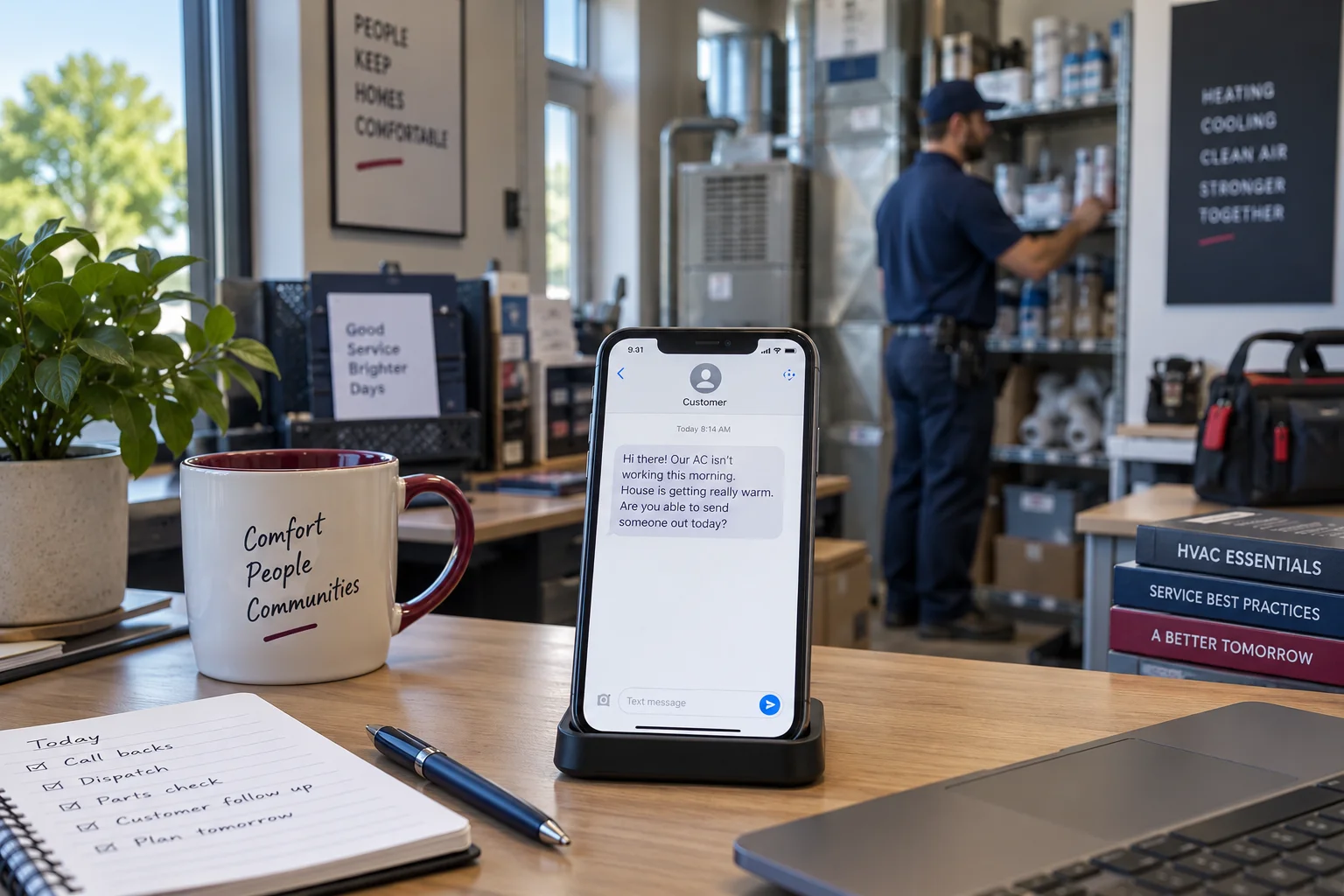
An HVAC company can respond to missed calls automatically by connecting its phone system to a workflow that sends an appropriate acknowledgment, collects basic service details, and alerts the person responsible for follow up. The response should help the customer take the next step without promising an appointment or arrival time that your team has not confirmed.
Why it matters
Picture a hot afternoon when your office is handling an installation question and two technicians are finishing repairs. Another homeowner calls about an air conditioner that has stopped cooling. The call goes unanswered, and the customer starts looking for someone else before anyone checks voicemail.
A useful automatic response keeps the conversation open. It could say, ‘Thanks for calling. We couldn’t answer just now. What ZIP or postal code is the property in, and what can we help with?’ That gives your team useful context while making it clear that the call was received.
The first message should sound like your business. Avoid pretending that a person has reviewed the request when nobody has. If the office is closed, say so. If a member of the team must confirm availability, explain that before offering the customer a next step.
Build the handoff after the first message
Start by defining which calls trigger the workflow. An unanswered new inquiry may need a response, while a supplier calling repeatedly should not receive a fresh sales message every time. Existing customers with active jobs may need their request attached to the current service record instead.
Next, decide what information belongs in the conversation. For most initial HVAC inquiries, the customer’s name, location, service need, and preferred contact method provide a useful starting point. Detailed diagnosis and technical recommendations should remain with qualified staff.
An illustrative calculation shows what is worth measuring. If your company receives 40 missed calls in a month and 15 are genuine new inquiries, those 15 deserve a clear outcome. Track whether each person replied, spoke with the team, booked, declined, or could not be reached. These are example figures, not a client result.
The workflow also needs an owner. If every reply lands in a shared inbox without an assigned person, automation has simply moved the bottleneck. Route responses to someone who can act, and create an escalation when the conversation sits unanswered during the agreed coverage period.
Delivery failures deserve attention too. Some numbers cannot receive texts, and some customers prefer a call. Your system should record failed delivery and create the appropriate alternative task instead of silently treating the inquiry as handled. Honor communication preferences and stop requests.
Before launch, test the same caller contacting you twice, a customer replying after closing, an unavailable appointment, and a message asking for a person. Check the actual phone integration as well: it must distinguish an unanswered call from a completed conversation before triggering outreach.
How Quantum Reach helps
Quantum Reach’s Speed to Lead System connects the inbound channels included in your scope with response, follow up, booking, and customer records. We map what happens after a missed call so the office receives a usable conversation rather than another disconnected notification.
For the scoped Speed to Lead offer, the promise is a response in under 60 seconds and launch within 21 days, subject to the written service terms. That concerns the system’s response and installation commitment. It does not mean a technician is available immediately or that every inquiry will become a booking.
A practical first step is the Free Lead Leak Report. It helps identify how a new inquiry is handled today. From there, the priority is straightforward: fix the point where an interested customer is waiting without a clear next step.
Actionable takeaways
- Review a week of missed calls and separate new inquiries from existing jobs, suppliers, and repeated calls.
- Write an acknowledgment that asks one useful question and accurately reflects your office hours.
- Assign ownership for replies, failed messages, and customers who request a phone conversation.
- Measure conversations and bookings alongside response time so you can see whether the workflow is helping.
For the broader framework, read our related guide.
How can an HVAC company respond to missed calls automatically?
An HVAC company can respond to missed calls automatically by connecting its phone system to a workflow that sends an appropriate acknowledgment, collects basic service details, and alerts the person responsible for follow up. The response should help the customer take the next step without promising an appointment or arrival time that your team has not confirmed.